
Hanuman Ji in Nashik & the Miracle of Neem Karoli Maharaj Ji: Anjaneri, Kainchi Dham and Ganga Ghat

A complete guide connecting Neem Karoli Maharaj Ji — revered by many as Hanuman Ji's own avatar — and his Kainchi Dham ashram in Uttarakhand, with Nashik's own Hanuman Ji heritage: Mount Anjaneri's birthplace tradition and the Hanuman Ji Mandir at Ganga Ghat.
Ask a devotee in Uttarakhand's Kumaon hills about Hanuman Ji, and they will likely mention a bald, blanket-wrapped saint who died in 1973 and whom thousands still believe never really left. Ask a trekker in the hills above Trimbakeshwar, and they will point you toward a misty plateau where, tradition holds, Hanuman Ji himself was born. Two ends of India, two very different stories — and yet both lead back to the same figure: Hanuman Ji, and the devotion he inspires wherever his story is told.
This guide connects them: the life and miracles of Neem Karoli Maharaj Ji, the North Indian saint many revere as Hanuman Ji's own avatar; his ashram, Kainchi Dham; and Nashik's own deep, layered relationship with Hanuman Ji — from Mount Anjaneri, traditionally honoured as his birthplace, to the Hanuman Ji Mandir and Maruti Pratima overlooking Ganga Ghat in the heart of the city.
Who Was Neem Karoli Maharaj Ji?
Neem Karoli Maharaj Ji — known to devotees simply as Maharaj-ji — was born Lakshman Narayan Sharma to a Brahmin family in Akbarpur village, Uttar Pradesh, around the year 1900. Details of his early life are sparse by his own choice; he rarely spoke of his birth family or his years before he began wandering as a sadhu, moving between ashrams and pilgrim towns across northern India, often appearing suddenly in a village, staying briefly, and departing without warning — a pattern of behaviour his followers came to see as entirely deliberate.
Over the following decades he became known by several names in different regions — Lakshman Das, Handi Wala Baba, Tikonia Wala Baba, and eventually Neem Karoli Maharaj Ji, the name that endured and the one by which he is remembered today. He passed away on 11 September 1973 at a hospital in Vrindavan, but for the tens of thousands of devotees — Indian and, increasingly from the late 1960s onward, Western — who now visit his ashrams every year, his presence is described as very much continuing.

The Miracle That Named a Village: The Train Story
The best-known story of Neem Karoli Maharaj Ji's life is also the one that gave him his enduring name. As the story is told and retold by devotees, Maharaj-ji was travelling by train without a ticket and was forcibly removed by railway staff at a small station called Neeb Karori. He simply sat down on the platform. Shortly afterward, the train — by every devotee account, without any mechanical explanation — refused to move. Only after railway officials pleaded with him to reboard, so the train could continue, did it start again — and, the story goes, he agreed to return only on two conditions: that the village be given a proper railway station, and that sadhus travelling through be treated with dignity and respect going forward.
Whatever one makes of the supernatural detail, the story's aftermath is concrete: the village took his name, Neeb Karori, which in time softened in everyday speech to "Neem Karoli" — and it is by that name, not his birth name, that the saint is remembered by millions today.
Is Neem Karoli Maharaj Ji an Avatar of Hanuman Ji?
Among his devotees, Neem Karoli Maharaj Ji's identity is inseparable from Hanuman Ji's. Some describe him as a great siddha, a realised saint who had transcended ordinary human limitation; many others go further, holding that he was Hanuman Ji himself, present on Earth in human form. This belief rests less on any single proof than on a pattern — decades of anecdotes describing him healing the sick, appearing in two places at once, materialising food or objects for a gathering with no visible source, and, in a handful of accounts, briefly manifesting in a form devotees identified as Hanuman Ji's own.
It is also worth being honest about what this is: a matter of devotional belief and lived experience for those who hold it, not a historical claim that can be independently verified — and Maharaj-ji himself is said to have deflected questions about his own nature far more often than he answered them, generally redirecting devotees back toward Ram Naam — the chanting of Rama's name — and toward serving others, which he treated as the actual substance of Hanuman Ji's own devotion, and the one thing genuinely worth imitating.
Kainchi Dham: The Neem Karoli Muth in North India
The clearest physical expression of the Hanuman Ji–Maharaj-ji connection is Kainchi Dham, the ashram he established in the Kumaon hills of Uttarakhand. Set on the Nainital–Almora road roughly 17 km from Nainital and about 8 km from Bhowali, at an elevation of around 1,400 metres, the ashram takes its name — "Kainchi", meaning "scissors" in Hindi — from two sharp hairpin bends in the mountain road that together form a scissor-like shape beside the Kosi river. Neem Karoli Maharaj Ji established the ashram in the early 1960s (commonly dated to 1962, with the main temple structure completed by 1964), and a Hanuman Ji temple sits at its very centre — the ashram's spiritual and architectural focal point.
Kainchi Dham holds an annual fair (mela) every 15 June, drawing close to a lakh (100,000) devotees from across Uttarakhand and neighbouring states in a single day. The ashram is also, somewhat unusually for a Himalayan hill temple, internationally known: Steve Jobs visited in 1973, in the period before founding Apple, and the ashram's influence on his worldview is well documented in his own later recollections; Mark Zuckerberg and Julia Roberts are among the more recent well-known visitors, alongside Ram Dass (Richard Alpert), the American spiritual teacher whose own writings on his time with Maharaj-ji introduced the ashram to a wide Western audience from the 1970s onward. A second major ashram associated with Neem Karoli Maharaj Ji stands in Vrindavan, Uttar Pradesh, where his samadhi (memorial shrine) can also be visited.


Hanuman Ji's Roots in Nashik: Mount Anjaneri
While Kainchi Dham represents Hanuman Ji devotion expressed through a 20th-century saint, Nashik's own connection to Hanuman Ji runs back to his very birth. Around 20-25 km from central Nashik, along Trimbak Road and close to Trimbakeshwar, rises Anjaneri — a hill in the Trimbakeshwar range of the Sahyadris, reaching roughly 1,300 metres (4,264 feet). The hill takes its name from Anjani, Hanuman Ji's mother, and local as well as scriptural tradition holds that it is where she gave birth to him.
According to the Bhavartha Ramayana, Anjani Devi performed severe penance on this very hill for 7,000 years, and Lord Shiva, moved by her devotion, chose to incarnate as her son — Hanuman Ji — on these slopes. A temple to Anjani Mata stands near the summit today, and the wider hill is also home to ancient Digambar Jain caves, waterfalls, and small lakes, making it both an active pilgrimage site and one of the more popular trekking destinations near Nashik, especially through the monsoon months when the plateau turns a vivid green.
The claim carries real institutional weight, too: in 2020, the Maharashtra government's Tourism Minister, Aditya Thackeray, announced plans to develop Anjaneri specifically as Hanuman Ji's birthplace, following the start of Ram Temple construction in Ayodhya — with an explicit commitment to environmental sensitivity that led to the shelving of a previously proposed 14-km road project through the hills, after protests from local environmentalists.

One Hill, Many Claims: The Birthplace Debate
In the interest of the same honesty this guide tries to apply throughout: Anjaneri is not the only site in India that lays claim to being Hanuman Ji's birthplace. Anjanadri Hill, near Hampi in Karnataka, makes a similar and, in some national conversations, more prominent claim, and the question has occasionally become a matter of inter-state debate rather than settled fact. What can be said with more confidence is that Anjaneri's claim is genuinely old — rooted in the Bhavartha Ramayana, a well-established regional textual tradition, not a recent invention — and that for Nashik and Trimbakeshwar's own pilgrims, it has been the locally observed birthplace association for generations, independent of how the wider national conversation eventually settles.
The Hanuman Ji Mandir and Maruti Pratima at Ganga Ghat
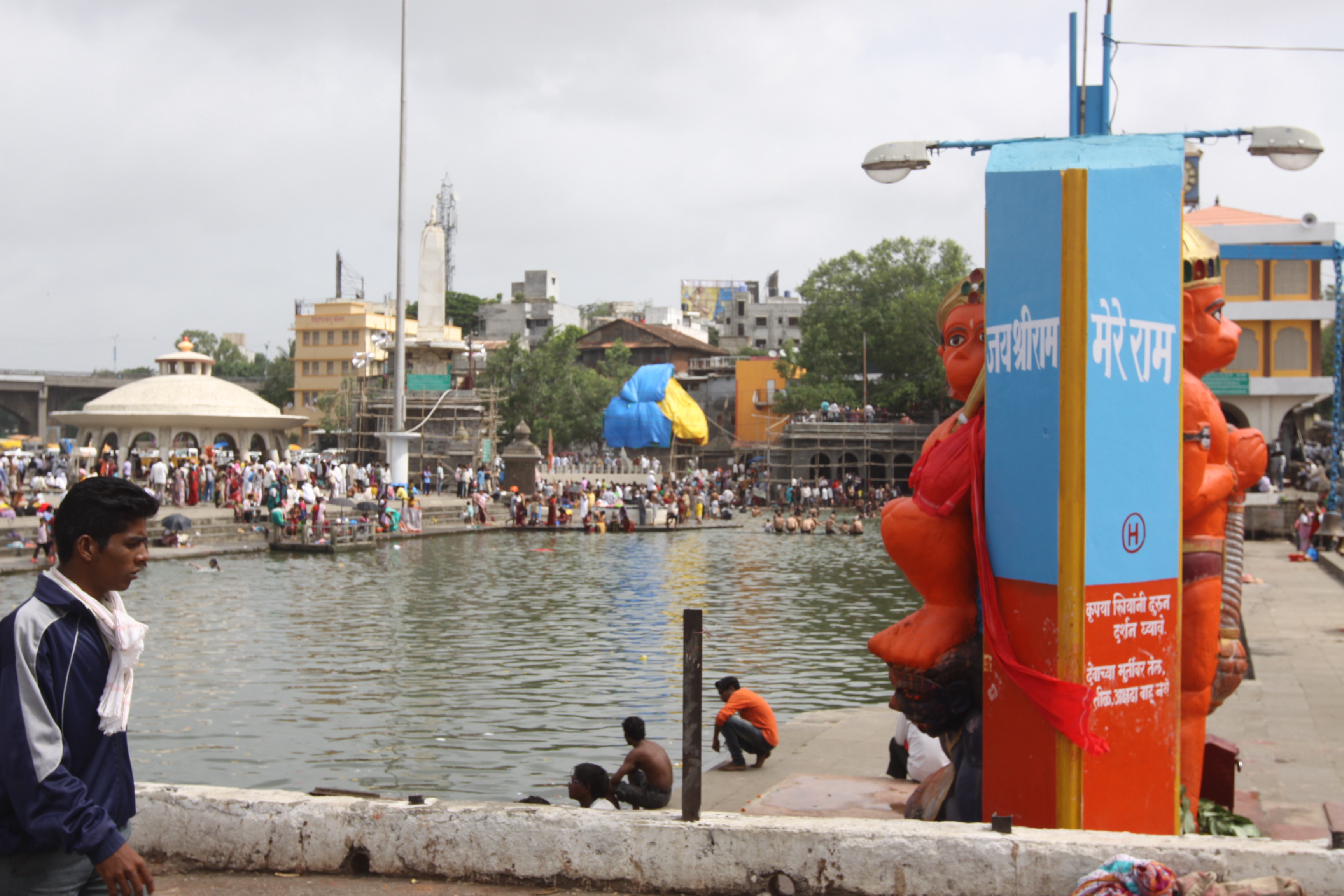
Closer to the centre of Nashik city, Hanuman Ji's presence is far more immediate and far less debated. Ganga Ghat, one of the bathing points along the Godavari in the Panchavati–Ramkund belt, is home to large, vividly painted Maruti (Hanuman Ji) statues that stand directly over the ghat's bathing steps — visible to every pilgrim taking a dip below, inscribed with devotional phrases like "Jai Shri Ram" and "Mere Ram". A short distance away stands Dutondya Maruti, one of Nashik's most distinctive Hanuman Ji shrines: a Hanuman Ji idol depicted with two faces — "Dutondya" translates roughly to "two-faced" — a genuinely unusual piece of iconography found in few other Hanuman Ji temples anywhere in India, and one that draws pilgrims and the simply curious in equal measure.
Together, the Ganga Ghat Hanuman Ji statues and the nearby Dutondya Maruti temple form one of the most visited, most photographed Hanuman Ji-devotional clusters in central Nashik — easily combined with a Ramkund visit, and, for pilgrims who have just read about Anjaneri and Kainchi Dham, a tangible, walkable reminder that Hanuman Ji's presence in Nashik isn't confined to a hillside legend twenty kilometres away — it's built directly into the city's own riverfront.
Two Ends of the Same Thread
Step back, and a clear thread runs across all of this. Nashik carries the story of Hanuman Ji's beginning — his birth on Anjaneri, his mother Anjani's penance, and a living devotional presence at Ganga Ghat and Dutondya Maruti in the heart of the city. Kainchi Dham, nearly 1,500 km north in the Kumaon hills, carries the story of Hanuman Ji's presence made new — in the person, teachings, and enduring miracle stories of Neem Karoli Maharaj Ji, whom generations of devotees have identified with Hanuman Ji himself. For a pilgrim visiting Nashik for the Kumbh Mela, that connection is worth knowing even if a trip to Uttarakhand isn't on the itinerary — it places Nashik's own Hanuman Ji sites inside a much larger, living devotional tradition that stretches across the length of the country.
Planning Your Visit
Anjaneri is reachable by road from Nashik in under an hour via Trimbak Road, and is easily combined with a Trimbakeshwar visit given its proximity — most visitors budget a half-day to a full day for the trek to the Anjani Mata temple near the summit, longer in the monsoon when the trail is more scenic but also more slippery. Ganga Ghat and Dutondya Maruti sit well within Nashik's central Panchavati–Ramkund pilgrim belt and are easily walkable from most stays in the area, making them a natural add-on to any Ramkund visit.
For those planning a separate trip to Kainchi Dham, the ashram is most commonly reached via Nainital or Bhowali in Uttarakhand, roughly a 3.5–4 hour drive from Kathgodam, the nearest railhead; the annual 15 June fair draws the single largest crowds of the year, so travellers seeking a quieter darshan may prefer to visit outside that date. For routes, timings, or help planning any part of your Nashik pilgrimage around these Hanuman Ji sites, ask Nashik Kumbh Yatri directly in chat.
Coming to Kumbh Nashik? Book Hotels, Parking & Restaurants
Plan the rest of your trip right here — chat with our AI assistant for an instant recommendation, or browse and book hotels, parking, event passes, and restaurants directly.
Sources
Ready to plan your Kumbh Mela trip?
Book hotels, parking, and event passes near Ramkund in one AI chat.
