Ghatasthapana: Katha, Arti, Vidhi and Significance of Kalash Sthapana
The story behind Navratri, the step-by-step kalash sthapana, the arti families sing and what the ritual means.
Ghatasthapana, also called Kalash Sthapana, is the first ritual of Navratri. This Nashik Kumbh Yatra guide explains it step by step. A clay pot of sacred soil is prepared, barley or seven grains are sown, and a kalash of water is set up to invoke the Goddess into the home for nine days. Sharad Navratri 2026 begins with Ghatasthapana on 11 October. This guide covers the katha behind the festival, the step-by-step vidhi, the meaning of the kalash and the sown grains, the rules of the ritual, the arti families sing, and the wider significance. It is for families setting up the kalash for the first time, and for visitors who want to plan their stay through nashikkumbhyatri.com.

What Is Ghatasthapana?
The word means 'establishing the ghat', the clay pot. It has two central symbols: the grains sown in the clay, which stand for life and growth, and the kalash set on top, which is the Goddess's seat. It is not only decoration. It is a resolve: for nine days the home is kept in an atmosphere of devotion, restraint and service.
The Katha — Why the Goddess Is Invoked
The tradition tells how the demon Mahishasura gained a boon from Lord Brahma that no man or god could kill him. Drunk with power, he overthrew the heavens and drove the gods out. The gods' combined energies took the form of Maa Durga, and each god gave her a weapon: Shiva a trident, Vishnu the Sudarshana chakra, Indra the thunderbolt, and others their own arms.
For nine days and nights they fought. Mahishasura kept changing form, into a buffalo, a lion, a man and an elephant, and each form was defeated. On the tenth day, Vijayadashami, the Goddess defeated him. Ghatasthapana marks the start of that battle: the household invites the Goddess to be present for nine days of worship and protection.
The details of the story vary between regions and texts, so families often tell it in their own way. The core themes of courage, devotion and the victory of good over evil are shared.
The Vidhi — Step by Step
- Prepare the place: clean the puja corner, spread a clean cloth, and bathe before the ritual.
- Layer the pot: put soil in the clay pot in three layers, scattering seven grains or barley seeds on each layer, then cover lightly with soil.
- Set the kalash: tie the sacred thread around the neck of the small kalash, fill it with clean water, and drop in a supari, perfume, durva grass, rice and coins.
- Add the leaves: place five mango or ashoka leaves around the rim, and cover with a lid.
- Crown the kalash: wrap the coconut in red cloth, tie it with thread, and place it on top of the kalash.
- Place it on the grains: set the kalash on the sown pot in the auspicious Pratipada window, not at night or on Amavasya.
- Invoke and worship: invoke Goddess Durga into the kalash, then perform the panchopachara puja (lamp, incense, flowers, scent and food).
This sequence follows the Drik Panchang ghatasthapana guide. Some families add their own steps; the core is the kalash, the grains and the invocation.

The Samagri for Ghatasthapana
| Item | Why it is used |
|---|---|
| Clay pot (ghat) and clean soil | The base in which barley is sown |
| Seven grains (sapta dhanya) or barley seeds | Sown in three layers; they sprout over the nine days |
| Small kalash (pitcher) with clean water | The vessel in which the Goddess is invoked |
| Sacred thread (moli), supari, coins, perfume | Tied to the kalash; offered as auspicious items |
| Five leaves (mango or ashoka) | Placed around the rim of the kalash |
| Unbroken rice, durva grass, flowers | Offered and placed in the kalash |
| Coconut wrapped in red cloth | Set on top of the kalash as the crown of the vessel |
| Red cloth, lamp (diya), ghee, camphor, incense | For the five-step puja (panchopachara) |
Rules for Ghatasthapana — Do and Do Not
- Do: perform Ghatasthapana in the morning, while Pratipada prevails.
- Do: keep the water in the kalash fresh, and water the sprouting grains regularly.
- Do: keep the spot clean and quiet; no footwear or rubbish near it.
- Do not: perform Ghatasthapana at night or on Amavasya.
- Do not: remove the kalash or the pot before the nine days are complete; follow your family's tradition for visarjan.
Significance of the Kalash and the Sown Grains
The kalash is the vessel of the Goddess's presence. Its water stands for abundance and the life-giving power of nature, the coconut for completeness and blessing, and the mango or ashoka leaves for auspiciousness and good health. The sown grains are a sign of growth: they sprout over the nine days, and at the end of Navratri the sprouts are taken as a blessing and shared within the family. The whole ritual is a reminder that the home is made sacred by daily devotion, and that growth needs care for nine days.
The Arti — Jai Ambe Gauri
Families sing the standard Durga arti in the morning and evening. The opening couplet of the widely sung 'Jai Ambe Gauri' arti is:
तुमको निशिदिन ध्यावत, हरि ब्रह्मा शिवरी॥
Meaning: Victory to Ambe Gauri, O Mother; victory to Shyama Gauri. Day and night Hari, Brahma and Shiva meditate on you.
During the arti the lamp is turned in a plate, and everyone present claps and sings along. Prasad is shared afterwards. For the full arti, use a complete, trusted text; the opening lines above are the most widely recognised part.

Mantras During Navratri
After Ghatasthapana, the aarti is done morning and evening. Many families chant the Navarna mantra: Om Aim Hreem Kleem Chamundayai Vichche. It is regarded as a praise of the Goddess in her nine-syllable form, and it can be chanted with a japa mala.
Beyond the Ritual — Darshan in Nashik
In Nashik, many families visit the Saptashrungi Devi temple at Saptashrungi Gad during Navratri, and the Shaktipeeth draws lakhs of devotees in the spring and autumn festivals. The shrine is cut into the rock face near the village of Nanduri, about 60 km north of Nashik city.

Maharashtra's Three-and-a-Half Shaktipeeths
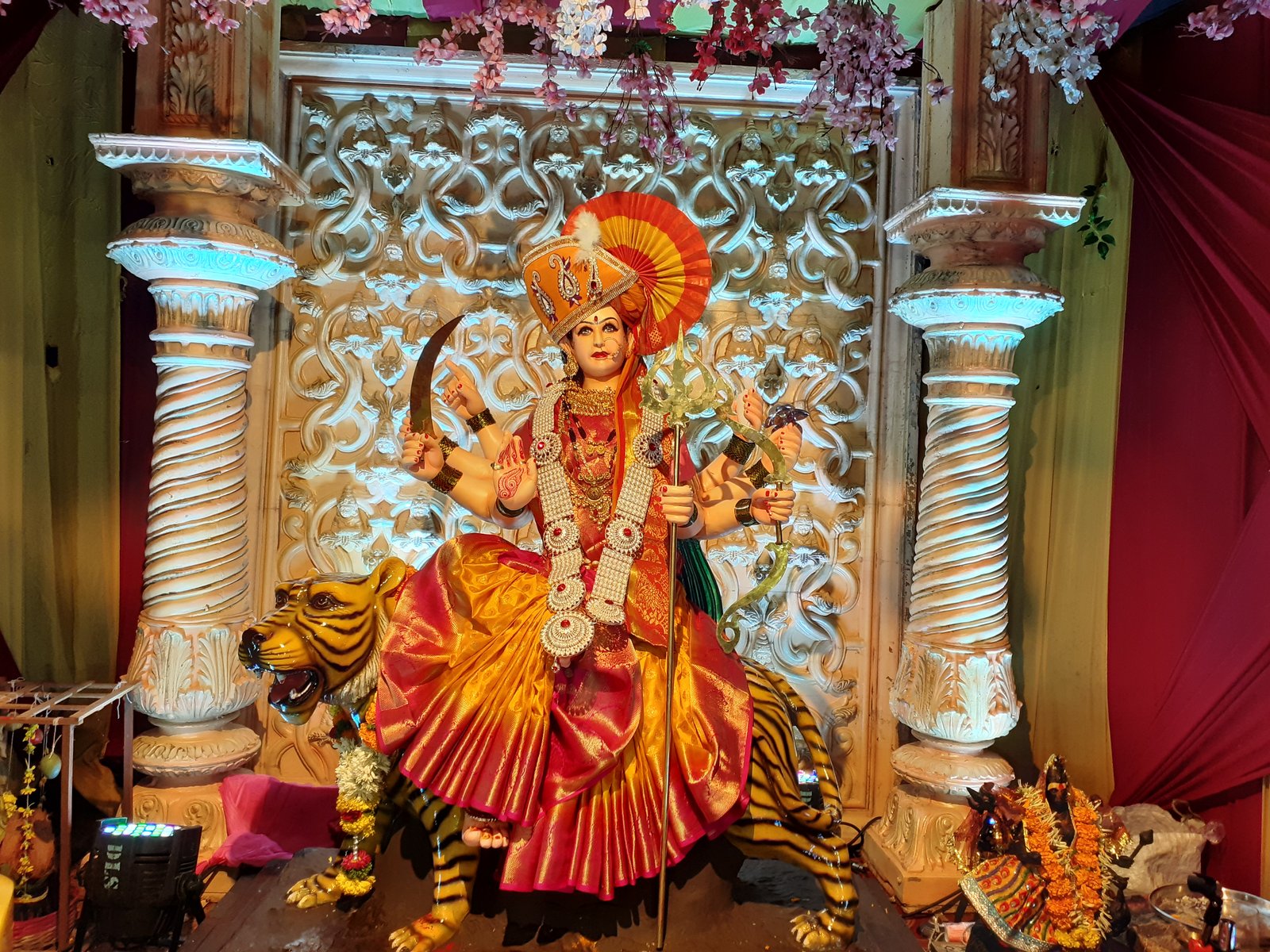
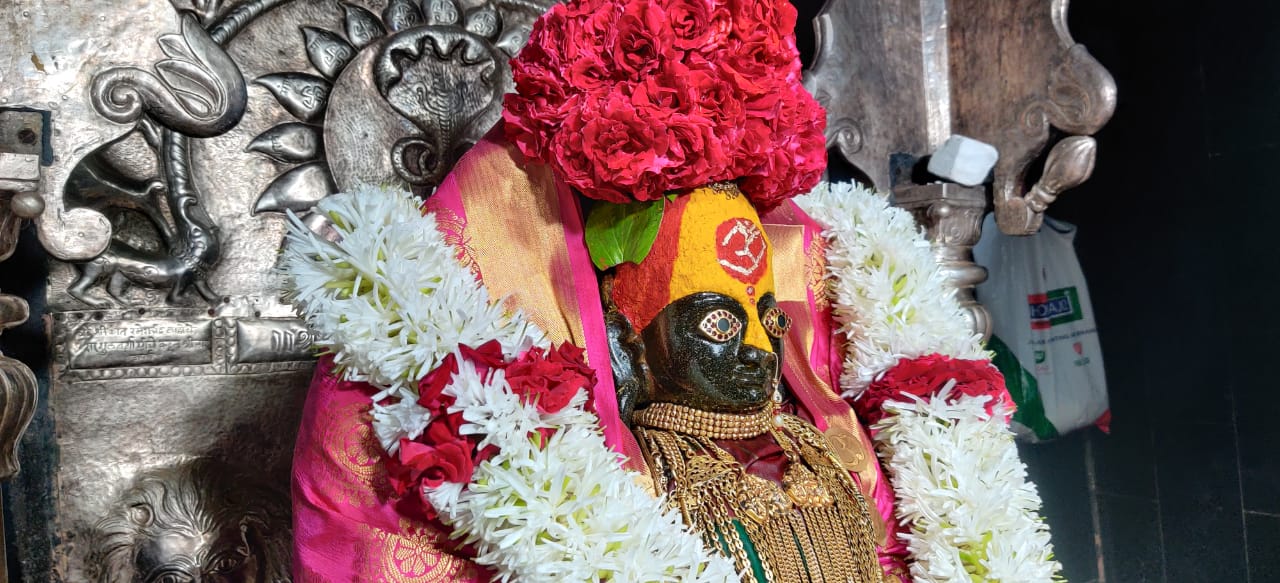
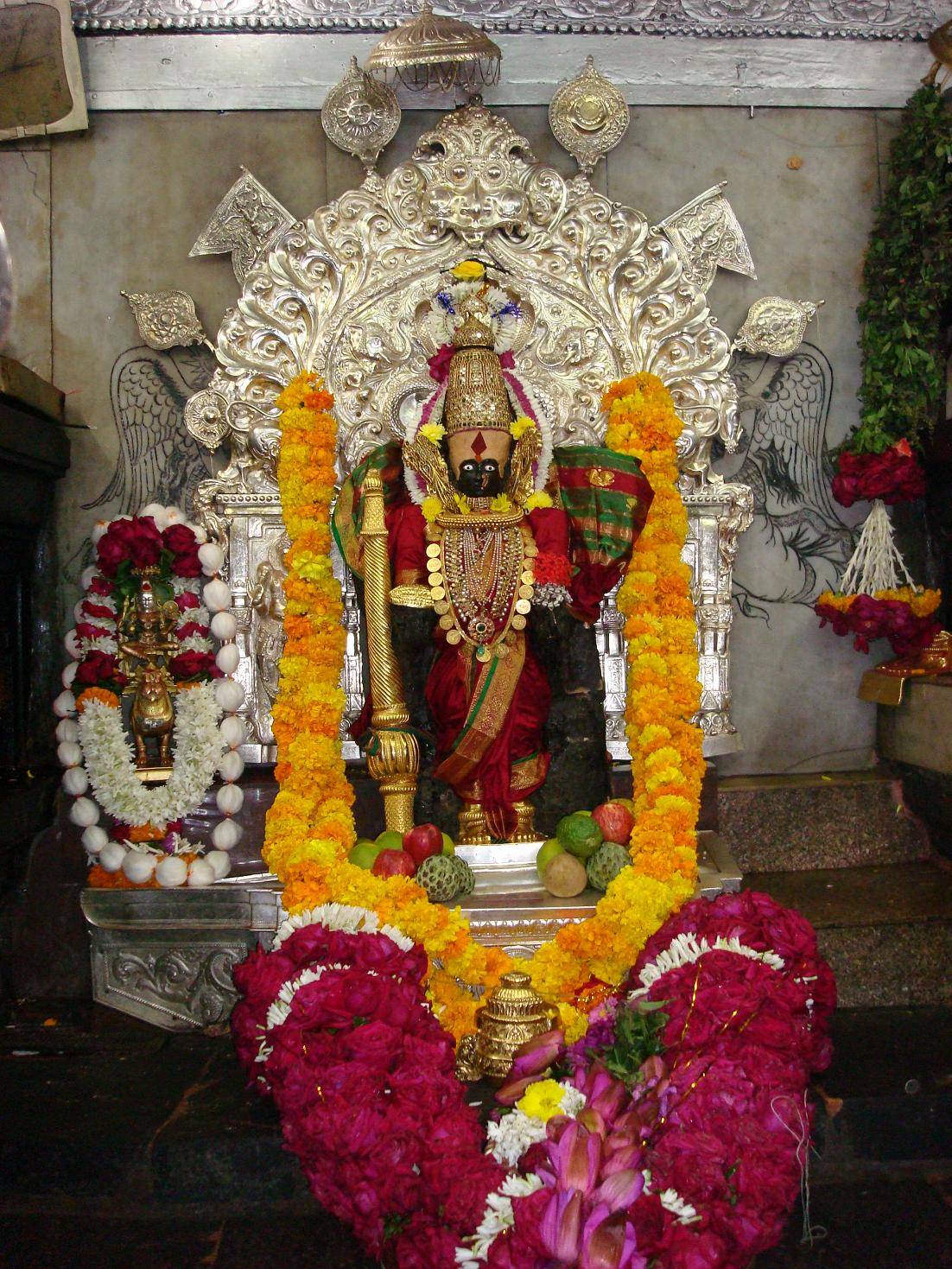
The photo above shows Maa Saptashrungi, near Nashik. Maharashtra is home to what are called the three-and-a-half Shaktipeeths of the Goddess: Saptashrungi Devi, Tulja Bhavani at Tuljapur (shown in the hero image above, and regarded as the kuldevi of Chhatrapati Shivaji Maharaj, closely linked to the Shastra Puja of Vijayadashami), Mahalakshmi (Ambabai) at Kolhapur, and Renuka Devi at Mahur (the 'half'). All four draw very large crowds during the nine nights of Navratri.
Frequently Asked Questions
When is Ghatasthapana in 2026?
Sunday, 11 October 2026, during Pratipada. Do it in the morning, and check your local panchang for the exact muhurat.
Why is the barley sown?
The barley sprouts over the nine days, a symbol of growth and prosperity for the household.
Can I do Ghatasthapana at night?
The sources reviewed say no: the ritual is done in the morning while Pratipada prevails, not at night or on Amavasya.
What goes into the kalash?
Clean water, a supari, perfume, durva grass, whole rice and coins. The neck is tied with a sacred thread, and mango or ashoka leaves are set around the rim.
Is the katha the same everywhere?
The core is the same, but details vary by region and text. Families often tell it in their own way.
Is this guide an official source?
No. It is an independent guide built from published Navratri and panchang sources. For temple timings and official notices, check the temple or local authority directly.
Book hotels, dharamshalas, parking slots and restaurants in Nashik and Trimbakeshwar in one place — or just tell our AI assistant what you need.
Sources
Ready to plan your Kumbh Mela trip?
Book hotels, parking, and event passes near Ramkund in one AI chat.